
Some odds and ends
It's been a bit busy round here...

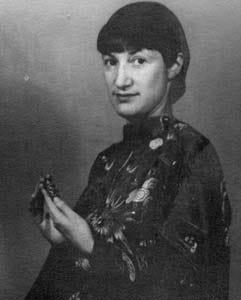
The good news is, that my book is coming on very well. I’m nearly half way through, ahead of schedule, and I am even remembering to try to footnote as I go. My worst memory from proofreading the Macmillan book was how many references and quotations I seemed to have just invented, it took me so long to find the source. So this time I’m thinking ahead. Also, I am having some lovely conversations with the children of the women I am writing about, mostly now in their eighties themselves, and delighted and intrigued that it is their mothers I want to talk about, not their more famous fathers. Next month I will be travelling to Eastbourne, to the Towner Gallery, where the works of Pearl Binder are currently on display, to hear one of her two daughters lecturing on her. I wrote about Polly, as she was known, last November.
The bad news is that I haven’t written an original Substack post for over a month. And today will be a bit scrappy, but I hope amusing? When I first started Substack, I used it to share the bits of the Macmillan story that didn’t make the cut, but seemed to me worth highlighting. Today I am going to share two wonderful bits of history that sadly won’t make it into Wives of Power - but I hope you will enjoy them.
The first is extraordinarily topical - today’s headline is that the birthrate in Britain is falling dangerously low - soon there won’t be enough young people to keep me in my old age. Very scary. But it is not a new worry…in the 1930s, the powers that be were similarly concerned about a falling birthrate, attributed to the Depression and of course to the shortage of available husbands. Before they could get round to doing anything about it the war broke out - but as the dust cleared in 1944, fearing that the situation would surely have deteriorated further, a Royal Commission on Population was established. Led by an eminent economist, Sir Hubert Douglas Henderson, it examined biological, social and economic factors that might be causing the problem. It finally published its report in 1949, but nothing resulted, as of course by then Britain was experiencing a very healthy post-War Baby Boom! Which was a shame, as it was full of very sensible suggestions aimed at improving the lives of mothers.
In among all the eminent scientists and economists and statisticians, it was felt that there needed to be some ordinary common sense, preferably someone who knew a little about motherhood and families, and the person they picked was Peggy Jay, already developing a reputation as a formidable Labour politician, a London County Councillor, with two small boys already and twins on the way.
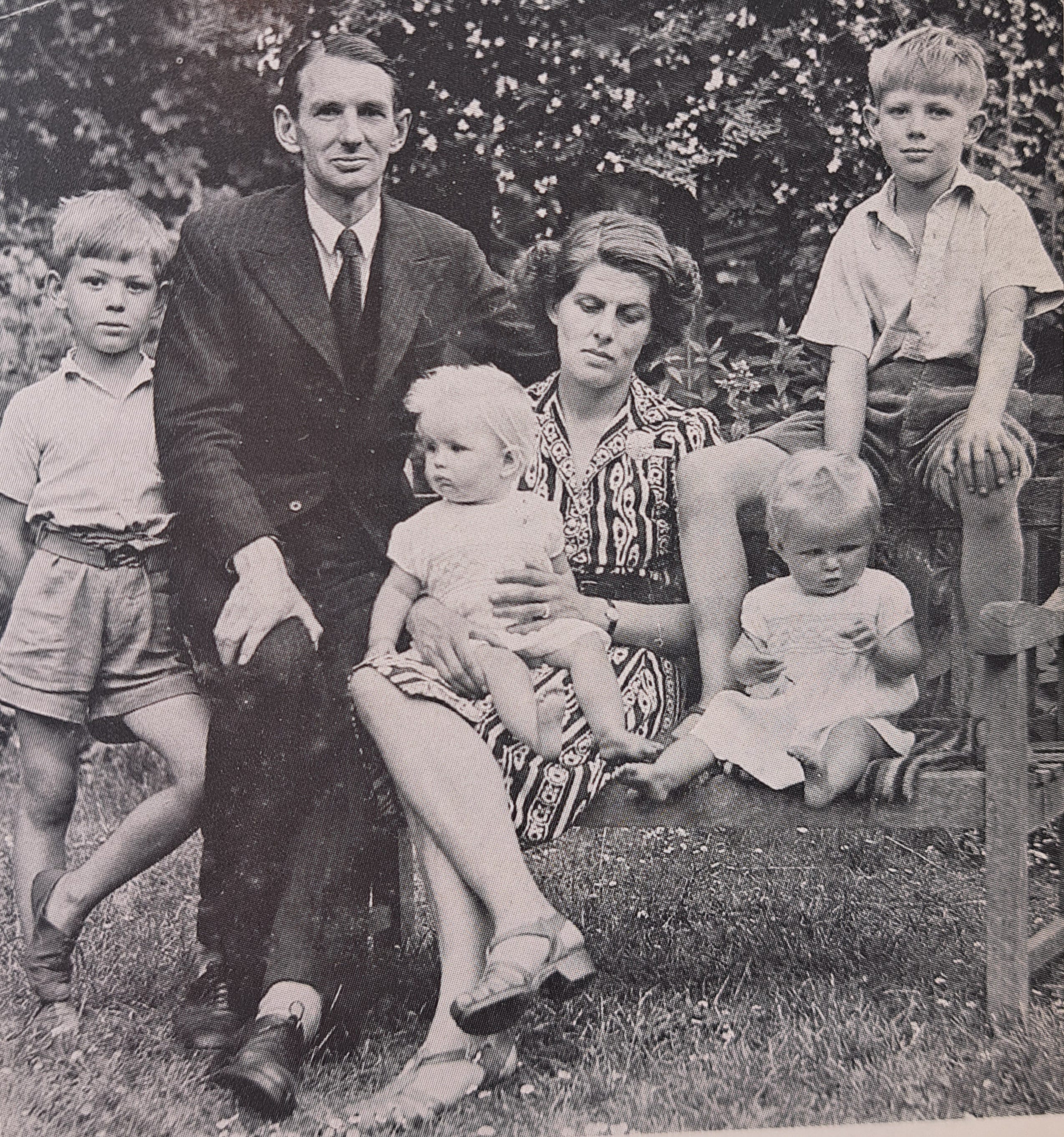
And in among her papers in the Churchill Archives in Cambridge is this wonderful document, a submission to the Commission from an extremely harrassed and unhappy mother.1 I want to share it with you:
A Woman’s Day, 25 September 1944
Since I have been asked to give an account of an average day, I think it well to give first some details of the family. My husband, an architect in peacetime, is a Flight Lieutenant, living at home. He leaves the house at 8.15am and returns at 7.35pm, with one free day one week and two the next. There are five children, three girls ages 12, 8 and 5 ½, and two boys 4 and ten months. The house is a large one, eight rooms on four floors. The only help I have is a daily ‘mother’s help’ from 9-6. If it were not for the assistance of relatives I should not be able to afford even this help as we have no resources other than my husband’s pay and allowances. I feel very strongly that if it is possible to organise help it should be at rates within the means of young parents with children.
An Average Day
5.45am Get up. Feed and dress baby and have cup of tea.
6.15 Dress myself and clear up
6.45 Get up 4 other children and start them dressing. The eldest dresses the 4 year old
7.15 Go downstairs and start breakfast
7.30 My husband does boiler and brings up coke and does fire in drawing room in winter.
7.30 12 year comes down and finishes breakfast while I finish getting the next three ready
7.45 Breakfast
8.15 Husband leaves. I get 8, 5 ½ and 4 ready for school and make six beds with help of 12 and 8
8.40 Eldest leaves for school
9am ‘Help’ arrives and takes 8, 5 ½ and 4 to school and does shopping
I put baby in pram and clear up nursery etc
9.30 Wash up breakfast and clear and sweep kitchen.
10.15-1pm Cook dinner for 4 to 7 people. The children come home for lunch except 12 year old, and the 8 and 5 ½ stay at school two days a week
Also either do drawing room, hall and stairs OR two children’s rooms on top floor OR basement and stairs OR Scrub kitchen floor OR washing clothes. ‘Help’ does nursery, our bedroom and bathroom and children’s washing, before fetching them from school at 12.30.
Ipm Lunch
2-3pm Wash up lunch and clear up kitchen which is a large one where we also have meals
3-4.15pm Finish housework not done in morning OR take baby to clinic OR by tube and bus for sunlight treatment
4.15pm Tea
5pm Rake and stoke boiler. Do odd jobs with children. Get baby’s pram ready and uncover beds – four children sleep in shelter, and the baby in pram and husband and myself in room adjoining in basement.
5.45-6.30 Put 5 ½ and 4 years to bed
5-6pm The ‘Help’ washes up tea and puts baby to bed.
6.30 Start 8 yrs old off to bed. Do ironing until 7pm
7pm Start supper
7.15pm 12 years has her supper
7.35 Husband comes home
7.50 Supper
8.30-9 Wash up supper and lay breakfast while my husband does shoes, boiler and brings up coke and does blackout
9-10pm Sit down and do mending, knitting, reading and writing letters etc
10pm Lift and change baby
11-11.15 In bed.
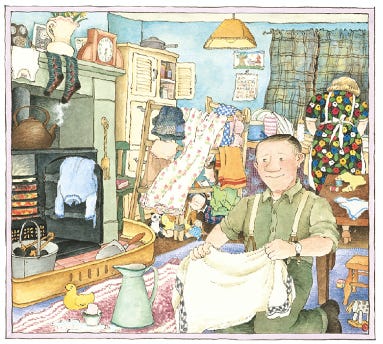
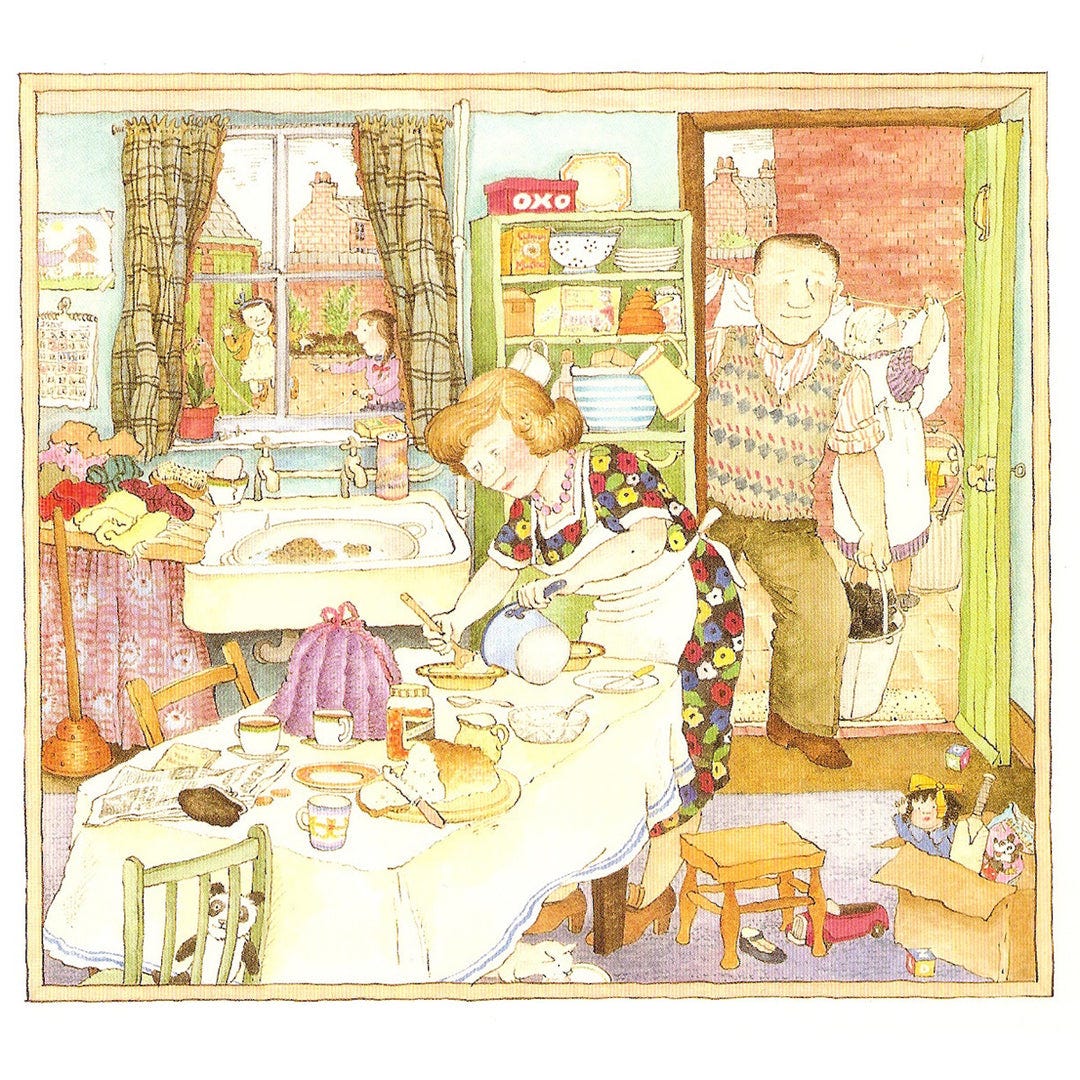
I think it is a wonderful social document. I had many thoughts while reading it, most of them involving sheer exhaustion, and huge gratitude to whoever invented central heating. It also made me feel that I was standing in the middle of one of my favourite children’s books, Peepo by Allan and Janet Ahlberg:
My second little nugget, this time of delight, was when I was reading Hansard, the Parliamentary document of record, to make sure I had my facts straight about another of my women subjects, Audrey Callaghan. Audrey, like Peggy Jay, was an extremely motivated and determined Labour councillor, a GLC alderman, and then from 1969 until 1982, the chair of Great Ormond Street Hospital for Sick Children. After she stepped down from this high profile role, she continued to be a very active fundraiser for the institution. In 1988 she spotted that the copyright on all royalties from JM Barrie’s work, Peter Pan, which he had gifted to GOSH, was due to expire. Her husband Jim, by this time Lord Callaghan in the House of Lords, proposed a private member’s amendment to the Copyright Bill then going through Parliament, which gave GOSH the right to these royalties in perpetuity. This right, the only one ever granted, exists to this day. Just three years after the legislation went through, Steven Spielberg released the film Hook and GOSH had its largest windfall ever:
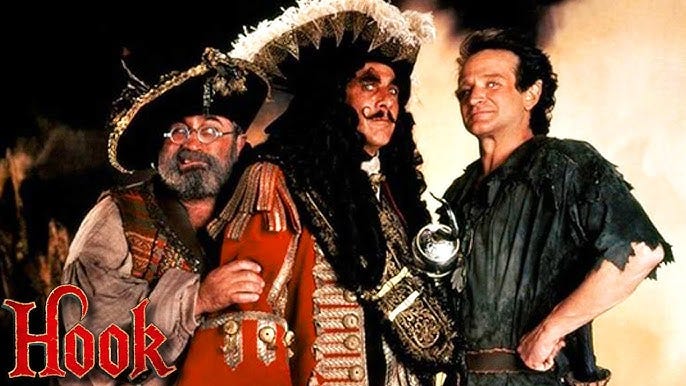
The debate in the House of Lords is a complete joy, it is somehow comforting to know that everyone can have a sense of humour, and that even Lords were children once. I should explain that the only dissenting voice was Lord Willis, formerly known as Ted Willis, a famous scriptwriter, creator of Dixon of Dock Green, who was very worried about the precedent being set. Here are my edited highlights of the debate:
Lord Willis:
My Lords, many years ago in America, during the McCarthy regime, it was customary and in fact necessary for a speaker to get up and say, “I want to assure my audience that I hate Stalin, I hate Russia, I hate everything to do with Communism, but I do think that our rates are too high”. I have to say that I like the noble Lord, Lord Callaghan, but I think that his amendment is wrong. I looked at it in wonder when I read it. I thought to myself, “How great is the power of ex-Prime Ministers; the song is ended, but the memory lingers on”.
Nobody in this House or outside it can exceed me in my desire to help sick children or the hospital. But what are we proposing in this amendment? We are asking the theatre to subsidise the National Health Service. A theatre puts on a production of Peter Pan and the money goes to the stricken hospital at Great Ormond Street. Where are we going down that path? There are many very good children’s charities, and there are very many good authors who have left legacies in their will to particular charities. I do not think that it is any part of the theatre’s job to subsidise hospitals in any way. I think that it is totally wrong…
Lord Ardwick:
My Lords, before my noble friend sits down perhaps I may ask him a question which is rather more personal than we are used to in this Chamber. Was he one of those cynical little boys who during the performance of Peter Pan refused to clap and so proclaim his belief in fairies and would have allowed poor Tinkerbell to expire? That is what he is doing this afternoon.
Lord Willis:
My Lords, I must tell my noble friend that one of my greatest friends was Tinkerbell.
Lord Charteris of Amisfield:
My Lords, I rise to support the amendment not simply because Captain Hook was an Old Etonian—and he was!—but for a slightly more personal reason. I suspect that I and my brother, the noble Earl, Lord Wemyss, who is not present this afternoon, may be the only two members of your Lordships’ House who, in company with their grandfather and six other children, had two plays especially written for them to act in by James Barrie. Not only did he write the plays for us; he also rehearsed us personally. I can tell your Lordships that it was a most terrifying and awe-inspiring experience. However, in spite of being a frightening man, he was a great lover of children and I know from what I remember of him that if he had realised what was going to happen he would have been absolutely fascinated and delighted by it. It is for that reason that I hope your Lordships will support the amendment, which is extremely imaginative. It is right that the work of James Barrie, which has given so much pleasure to children for so many years, should continue to bring comfort to those who are in trouble.
Baroness Strange:
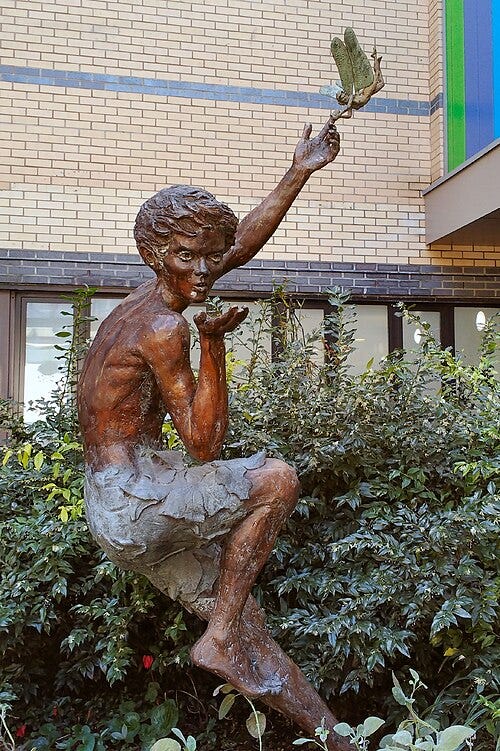
My Lords, J. M. Barrie once wrote that: “When the first baby laughed for the first time, the laugh broke into a thousand pieces and they all went skipping about, and that was the beginning of fairies”.
On that basis, if on no other, we must all believe in fairies. Fairies come in many guises, not only in tinsel dresses and with gauze wings. At all events they are little people who grant wishes and do good deeds around the world. We can do no greater good or give more lasting happiness than by accepting this amendment that has been put forward by the noble Lord, Lord Callaghan, so that the money from Peter Pan, J. M. Barrie’s own play about fairies, can go for ever to the sick children of the Great Ormond Street Hospital, and in future ensure that every time one of those children laughs more fairies are born to create more joy in the world.
The Debate eventually concluded with Lord Callaghan thanking the House for its support:
I am deeply grateful for what has been said. I suppose that the noble Lord, Lord Charteris, must be the only Member of this House who has the fortune, at this late stage, to have known Sir James Barrie personally.
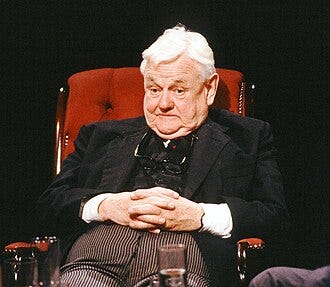
Lord Hailsham of Saint Marylebone:
My Lords, I knew him quite well.
Lord Callaghan of Cardiff:
My Lords, I might have known that the former Lord Chancellor knew him well! Perhaps I had better be careful what I say. I am not sure that he has been produced in a play that has been written specially for him by Sir James Barrie. At least let us give that distinction to the noble Lord, Lord Charteris. It accounts for a great deal in his character that I have come to like and admire in the years since.
One final thought: I am currently reading Mary Swann, a novel by Carol Shields, written in 1993. It concerns a group of people, some academics, some not, who are picking over the literary bones of a lesser-known poet from an Ontario farmstead. Shields has her tongue firmly in her cheek - could Mary Swann, poet, ever have imagined that her very primitive scribblings would be pored over and analysed to death in this way. One of the characters, the rather unfortunate Morton Jimroy, is trying to create a biography of this woman, out of the few whisps of straw that survive. But I will end on this rather excellent line, which Shields calls ‘a rather endearing piece of professional exposition:
“The oxygen of the biographer is not, as some would think, speculation; it is the small careful proofs that he pins down and sits hard upon.”’
Today I am sharing two of my small careful proofs with you. I hope you enjoy them.
With thanks to the Jay family for allowing me to quote from their mother’s papers.
Now, why aren't Lords (& Ladies') debates always like that? What a touching story, and Jim Callaghan is a hero for getting that amendment through. I did love seeing those Ahlberg illustrations again in the context of a real-life woman's experience! So detailed and endearing, but also accurate.
This is a delight, thanks, Sarah. The social document from a busy mother reminded me very much of a conversation I had with an aunt of mine many years ago. With quite a large family herself, she detailed their rigorous daily timetable, and disciplined routine and children's chore schedule. They even had regular fire drills. Thanks again. I look forward to your new book being published!