
Revisiting Anita Brookner
And trying to stay cheerful

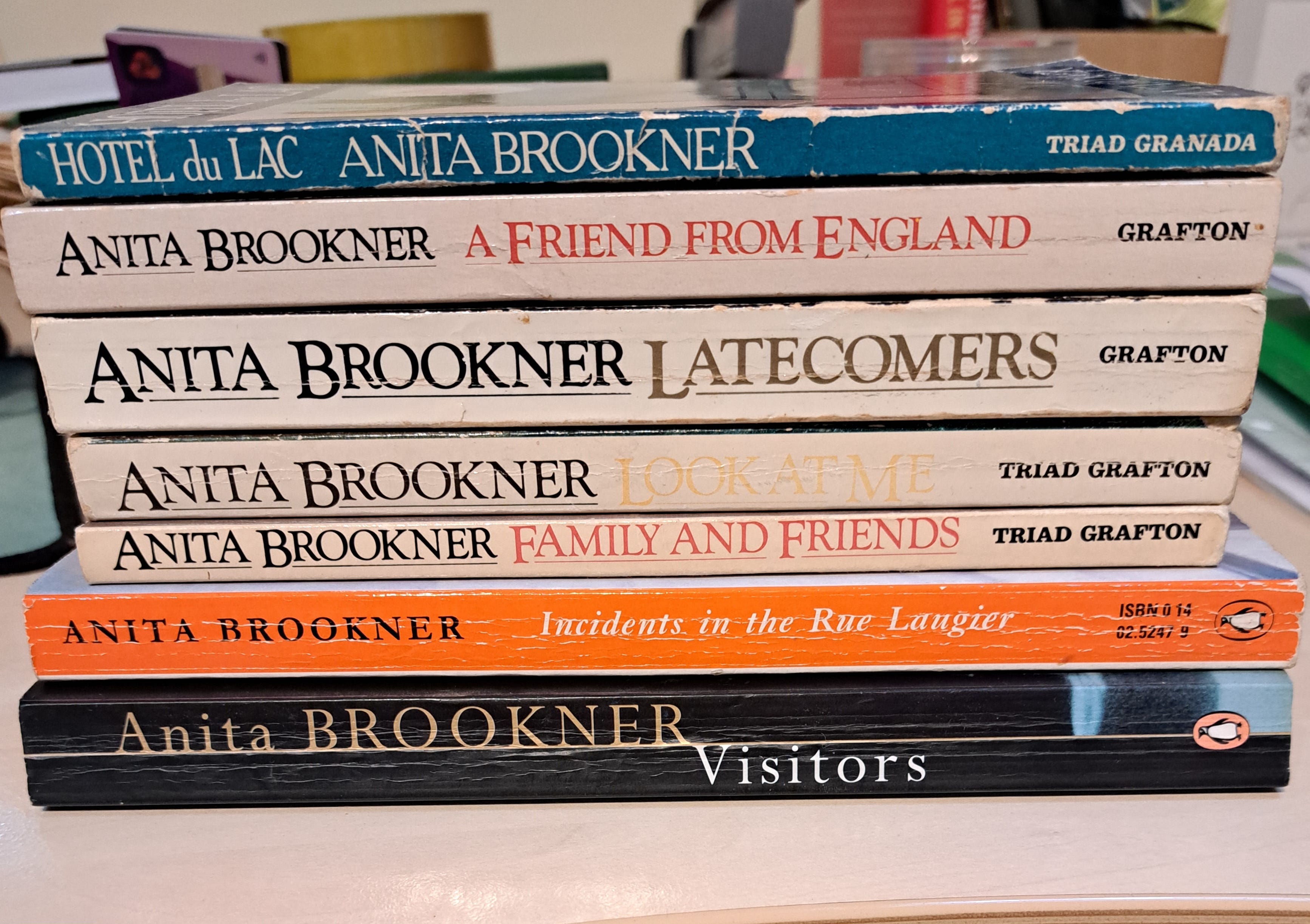
It is a long time since I read an Anita Brookner novel, so last week I picked up Visitors, her offering from 1997, with curiosity and anticipation. Would the magic still be there? The front cover blurb said ‘Anita Brookner is a modern Jane Austen.’ Well, yes, if Jane Austen had written very sad novels about lonely women growing old. It’s not what I remember Jane for.
To be fair to Miss Brookner, this was not the best week for me to be reading her work. It’s a very wet and depressing January, the news from outside just seems to get worse and worse, and I am struggling with my second stupid cold of the year, combined with the regular New Year weight gain and the anticipation of a nasty trip to the dentist. Suffice to say I am feeling my age. However, I think Anita was too when she wrote this.
Dorothea May, Thea to her [very few] friends and relations, is a widow in her early seventies, who has lived alone in her ground floor flat in Fulham since the death of her husband fifteen years ago. Her life seems to have become set in aspic: her only dealings with the outside world are the regular weekend visits to Kitty and Molly, her husband’s cousins, living a comfortable existence with their husbands in Hampstead. So much of this seemed very familiar ground to me, from my recollections of the novels I read thirty years ago or more. Brookner’s characters mostly seem to occupy well-upholstered flats in north-west London, the quarter so densely populated with refugees who fled Europe in the 1930s and 40s. This was Anita’s life as well, the only child of a secular Jewish family, originally from Poland, although her first home was Herne Hill in South London. Of course, Brookner had a very successful professional life, more so than any of her characters that I can remember. She was the first female Slade Professor of Fine Art at Cambridge University in the late 1960s, and until she retired in 1988 she was a Reader at the Courtauld Institute of Fine Art. She never married.
In Visitors, the dull but cosy life of Kitty, Molly and Thea is rocked when, unexpectedly, Kitty’s granddaughter Ann arrives from America, pregnant, with her fiancé David and his friend Steve. These three young people have to be accommodated, and a wedding arranged. Thea is strong-armed into giving up her spare room to Steve. The novel progresses - the three older women learn a little about themselves and a lot about this younger generation, most of it not to their taste. The wedding happens, the threesome leave, and life resumes. There are none of those cathartic moments of revelation which I remember so vividly from the Booker Prize-winning Hotel Du Lac, or from my personal favourite, Look At Me.
This is a novel about ageing, and about facing the certainty of death. So it was NOT what I should have picked up this rather difficult week. Indeed, one particular morning I found myself so close to tears reading it that I had to put it away. Who remembers Joey in Friends, putting Little Women in the icebox because he couldn’t cope with the death of Beth? I felt very sympathetic to him that morning. Brookner is ruthless about what it means to age:
The body would betray her; the body was therefore taboo, glanced at without amenity in the bath, and ignored once it was covered. It still functioned, more or less, although there were now pills to hand in both bedroom and bathroom. It was almost a comfort to her to know that there was no-one intimate enough to share the stoicism and distaste with which she endured herself.
And here she is, describing a woman in her eighties:
She wore a well-preserved hat of coq feathers, at least forty years out of date, and a dress of printed silk, the bodice of which, tactfully draped, could not quite conceal her completely flat chest. In contrast to her shrivelled body her hands were massive, the knuckles swollen by arthritis. Several fine rings were buried in the interstices.
Oh dear. Although I do quite admire the determination with which this elderly woman demands her share of the champagne and caviare on offer.
Thea May is experiencing what is so often discussed in print these days: the fading into invisibility of the older woman. Before her marriage she had worked in an office:
Those were the halcyon days of office work, before secretaries were known as personal assistants, with computer skills and an awareness of unfair restrictions, before hurt feelings led to industrial tribunals, before a compliment was perceived as sexual harassment, days when girls were free, outside of office hours, to enjoy their money and their liberty.
A touch of misplaced nostalgia here, I feel.
Then Thea met Henry, married him, travelled with him, fashioned a place, slightly uncomfortably, within his family, nursed him through his illness, and buried him. The arrival of Ann, David and Steve, so obviously contemptuous of her complacency, her static lifestyle, challenges her. Could she have done more? ‘Young people are aware of endless possibilities, either in this world or the next…When you get old you realise how limited those possibilities really were, and you regret the fact that you made so little of them’.
How much of this is Anita Brookner speaking for herself or for what she recognised in other women of her generation? She was approaching seventy when she wrote the novel, an impeccably dressed, beautifully poised woman with a string of successful books and prizes burnishing an already illustrious career in the art world. A woman who had re-invented herself, publishing her first novel at the age of fifty-three. Nevertheless, apparent success in the material world is of little comfort in the wee small hours. This novel is a heart-breaking exploration of what haunts so many people as they approach their final years, particularly those for whom achievements were few and far between. It is a recognition of the courage that is needed to continue, as if unaware of the one certainty in life…
Courage to live alone, yes, and to die alone when the time came; courage to meet the empty day formally dressed and scented; courage to confront long endless Sundays, sustained only by a diet of newspapers and walks round the garden, the latter curtailed in case she was observed by idlers at their windows.
It is a bleak picture. So I am not recommending Brookner to anyone feeling a bit sad! But I still was drawn in by her immaculate prose, every word finely judged and placed. By her little glimpses of the pleasures still to be had in life… ‘the carton of minestrone, an onion tart, some salad leaves, a wedge of Dolcelatte and six fine peaches’. I will be revisiting some of the other well-thumbed Brookner volumes on my shelf, hoping to find something slightly more upbeat than Visitors. And I am going to leave you with one of my favourite poems, a different take on growing old, and one that contains much to aspire to.
New Fruit, by Ann Drysdale
In the last knockings of the evening sun
Eve drinks Calvados. Elsewhere in her life
She has played muse and mistress, bitch and wife.
Now all that gunpoint gamesmanship is done.
She loves the garden at this time of day.
Raising her third glass up to God, she grins;
If this is her come-uppance for her sins
It's worth a little angst along the way.
A fourth. Again the cork's slow squeaky kiss.
If, as the liquor tempts her to believe,
The Lord has one more Adam up His sleeve
He's going to have to take her as she is -
Out in the garden in a dressing-gown
Breathing old apples as the sun goes down.
Sorry you haven't been well. Teeth! They are God's little joke!
I think everyone is feeling glum at the moment - it has been a very long winter.
The good thing about reading a book like this is that it represents the human condition so well. She shows us that we are not alone in these feelings and yes, courage is the key. I often think that if I am feeling fearful of the future. as Dylan Thomas said "Do not go gentle into that good night/Rage, rage against the dying of the light"! I also relate to the idea that small pleasures can bring a disproportionate amount of pleasure.
Thanks for a really enjoyable read. The extracts are marvellous.
I enjoyed the poem too.
Visitors is a PARTICULARLY depressing one as I recall... she is truly fearless! Lovely to read about her.